In the domain of residential surfaces, polymers bridge the chasm between budget-conscious manufacturing and seamless aesthetic installations. Unlike crystalline minerals or metallic lattices, synthetic polymers rely on long-chain molecular formations intertwined with mineral fillers. Understanding their physical tolerances requires dissecting Barcol, Rockwell, and Shore durometer scales under actual household usage conditions.
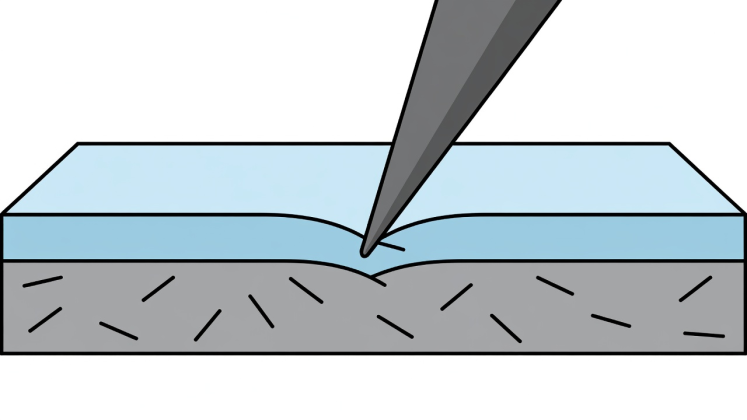
Acrylic Solid Surfaces (PMMA with ATH Fillers)
Pure acrylic solid surfaces consist of approximately one-third polymethyl methacrylate resin and two-thirds aluminum trihydrate (ATH) derived from bauxite ore. This specific formulation yields distinct physical behaviors:
- Barcol Hardness Value: Typically tests between 56 and 62 on the Barcol 934-1 scale. While substantially softer than architectural glass (which exceeds 80 equivalent), this allows the material to absorb micro-impacts without shattering.
- Homogeneous Matrix: Coloration and particle distribution run completely through the 12mm sheet thickness. Consequently, physical scratches do not expose an alternate substrate beneath.
- Renewable Surface Plane: Using progressive silicon carbide abrasive pads (240-grit through 600-grit), homeowner or technician can buff out superficial knife drag lines without structural degradation.
High-Pressure Decorative Laminates (HPL)
HPL panels represent an engineering marvel of paper and thermosetting resins. Kraft paper sheets impregnated with phenolic resin form the structural core, while an alpha-cellulose decorative paper treated with melamine resin forms the exterior wear plane.
During high-pressure pressing (exceeding 7 MPa at 140°C), the melamine thermoset cross-links into an intensely rigid, glass-like crystalline polymer layer. Melamine provides superior surface scratch resistance compared to ductile acrylics, but carries a major operational flaw: edge impact brittleness and delamination risk if water reaches the kraft paper core.
Comparative Polymer Metric Index
| Polymer Variant | Tensile Modulus (GPa) | Deflection Temp (0.45 MPa) | Solvent Vulnerability |
|---|---|---|---|
| 100% Cast PMMA Acrylic | 3.1 – 3.3 | 95 °C | Degraded by acetone, chlorinated hydrocarbons |
| Melamine Formaldehyde (HPL Cap) | 7.0 – 9.0 | 145 °C | Resistant to alcohols, vulnerable to prolonged bleach |
| Unsaturated Polyester Casting | 2.8 – 3.5 | 75 °C | Micro-crazing under ethanol and aromatic solvents |
| Polycarbonate Fixture Shields | 2.4 | 135 °C | High scratch susceptibility; requires siloxane coating |
Thermal and Chemical Degradation Modes
The primary Achilles' heel of household polymers remains their glass transition temperature (Tg). When hot culinary vessels are placed directly onto acrylics, the localized temperature frequently surpasses 160°C. At this threshold, secondary molecular bonds weaken, allowing plastic deformation, permanent blanching, and resin cracking. Similarly, harsh bathroom descalers containing sulfamic acid can pit decorative polymeric coatings over prolonged contact intervals.